

As a supplier of Glue Spreading Machines, I have witnessed firsthand the critical role these machines play in various industries, especially in the plywood manufacturing sector. The quality of glue spreading is of utmost importance as it directly impacts the bonding strength, durability, and overall quality of the final product. In this blog, I will delve into the key factors that affect the glue spreading quality of a Glue Spreading Machine.
1. Glue Properties
The characteristics of the glue itself are fundamental to achieving high - quality glue spreading. Different types of glue, such as urea - formaldehyde, phenolic resin, and melamine - formaldehyde, have distinct viscosities, solid contents, and curing times.
High - viscosity glue can be challenging to spread evenly. It may require a more powerful spreading mechanism to ensure that it can be uniformly distributed across the surface. If the viscosity is too high, the glue may accumulate in some areas and be insufficient in others. On the other hand, low - viscosity glue may flow too quickly, leading to glue dripping and uneven coverage. For example, in a plywood manufacturing process, a urea - formaldehyde glue with an inappropriate viscosity might result in weak bonding between the wood veneers.
The solid content of the glue also matters. A higher solid content can lead to a stronger bond, but it can also increase the viscosity. Therefore, it is essential to find the right balance. If the solid content is too low, the bonding strength may be compromised, and the glue may dry too slowly.
Curing time is another crucial property. Some applications require a fast - curing glue, while others can tolerate a slower curing process. The Glue Spreading Machine must be adjusted to accommodate the curing time of the glue. For instance, if the glue has a short curing time, the spreading process needs to be quick and efficient to ensure proper bonding before the glue starts to cure.
2. Machine Design and Condition
The design of the Glue Spreading Machine has a significant impact on the glue spreading quality. There are mainly two types of Glue Spreading Machines: roll - type and spray - type.

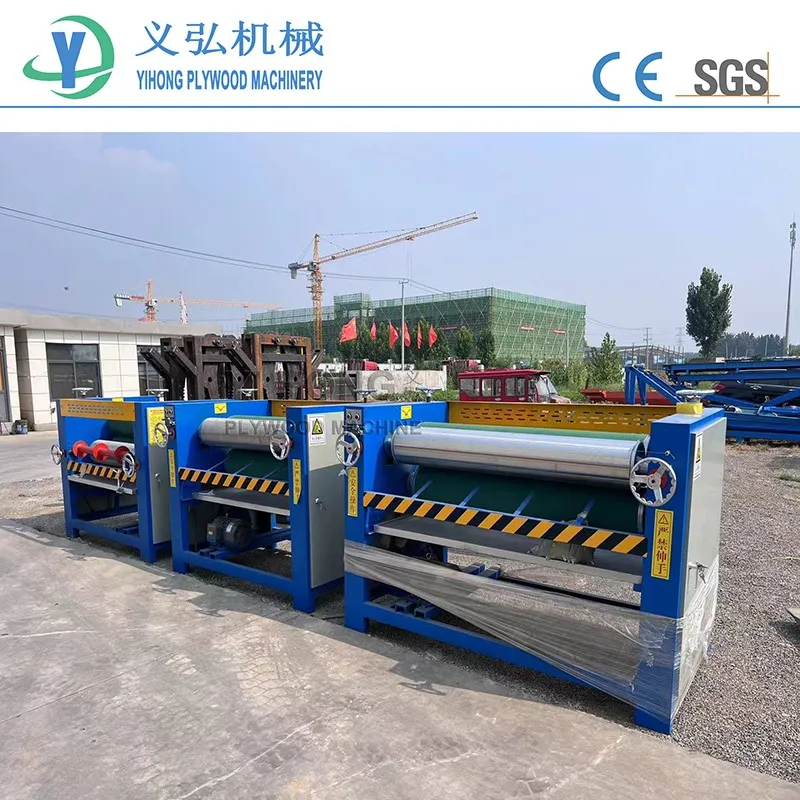
Roll - type Machines
Roll - type Glue Spreading Machines are widely used in the industry. The quality of the rolls is crucial. The smoothness, hardness, and surface finish of the rolls affect how the glue is transferred and spread. If the rolls are worn out or have a rough surface, the glue may not be evenly distributed. The gap between the rolls also needs to be precisely adjusted. A too - wide gap will result in a thin layer of glue, while a too - narrow gap may cause excessive pressure, leading to glue splashing or uneven spreading.
The speed of the rolls is another important factor. A higher roll speed can increase the production rate, but it may also make it more difficult to control the glue spreading. If the roll speed is too fast, the glue may not have enough time to adhere to the substrate evenly. Conversely, a very slow roll speed may lead to over - spreading and wasting of glue.
Spray - type Machines
Spray - type Glue Spreading Machines use nozzles to spray the glue onto the substrate. The design and condition of the nozzles are crucial. Clogged or damaged nozzles can cause uneven spraying patterns, such as streaks or patches. The pressure at which the glue is sprayed also affects the spreading quality. Too high pressure can cause the glue to atomize too much, resulting in excessive overspray and uneven coverage. Too low pressure may not be able to disperse the glue properly, leading to a thick and uneven layer.
Regular maintenance of the Glue Spreading Machine is essential. This includes cleaning the rolls or nozzles, lubricating moving parts, and checking for any mechanical failures. A well - maintained machine will operate more smoothly and produce a higher quality of glue spreading.
3. Substrate Characteristics
The nature of the substrate onto which the glue is being spread is also a determining factor. The surface roughness, porosity, and material of the substrate all play a role.
A rough - surfaced substrate can absorb more glue, but it may also require a higher amount of glue to ensure complete coverage. For example, in plywood manufacturing, rough - cut wood veneers may need more glue to fill in the surface irregularities and create a strong bond. On the contrary, a smooth - surfaced substrate may require less glue, but it can be more challenging to ensure that the glue adheres properly.
The porosity of the substrate affects how the glue penetrates. Highly porous materials, such as some types of wood, can absorb the glue quickly, which may lead to a thinner layer of glue on the surface if not properly controlled. Non - porous materials, like some plastics, may require a special type of glue or a surface treatment to ensure good adhesion.
The type of material also matters. Different materials have different chemical compositions, which can affect the chemical reaction between the glue and the substrate. For example, some metals may react with certain types of glue, leading to a weaker bond.
4. Operating Environment
The operating environment where the Glue Spreading Machine is used can influence the glue spreading quality. Temperature and humidity are two key environmental factors.
Temperature affects the viscosity of the glue. In a cold environment, the glue may become more viscous, making it difficult to spread evenly. In contrast, in a hot environment, the glue may dry too quickly, resulting in poor bonding. For example, in a factory located in a region with a cold climate, the glue may need to be pre - heated to ensure proper spreading.
Humidity can also impact the glue spreading process. High humidity can slow down the curing process of some glues and may cause the glue to absorb moisture from the air, which can affect its bonding properties. Low humidity, on the other hand, can cause the glue to dry too fast, leading to cracking and weak bonds.
Dust and debris in the operating environment can contaminate the glue and the substrate. This can interfere with the glue - substrate adhesion and result in a lower quality of bonding. Therefore, a clean and controlled operating environment is necessary for optimal glue spreading.
5. Operator Skills and Training
The skills and knowledge of the machine operator are often overlooked but are extremely important. An experienced operator can make precise adjustments to the machine settings based on the type of glue, substrate, and other factors.
The operator needs to understand how to adjust the glue flow rate, roll speed, or spray pressure correctly. For example, they should be able to increase the glue flow rate when spreading on a rough - surfaced substrate. They also need to be able to detect and troubleshoot problems quickly, such as abnormal glue spreading patterns or machine malfunctions.
Proper training is essential to ensure that the operator can operate the Glue Spreading Machine effectively. Training programs should cover machine operation, maintenance, safety procedures, and quality control. A well - trained operator can significantly improve the glue spreading quality and reduce production losses.
Conclusion
In conclusion, the glue spreading quality of a Glue Spreading Machine is affected by multiple factors, including glue properties, machine design and condition, substrate characteristics, operating environment, and operator skills. As a [Supplier description] of Glue Spreading Machines, we understand the importance of these factors and strive to provide our customers with high - quality machines that can meet their specific needs.
Our Glue Spreading Machines are designed with advanced technology to ensure precise glue spreading. They are also supported by comprehensive after - sales service, including operator training and maintenance support. We believe that by addressing all these factors, we can help our customers achieve the best possible glue spreading quality and improve their overall production efficiency.
If you are in the market for a reliable Glue Spreading Machine, or if you have any questions about our products, please feel free to contact us for further discussion and negotiation. We are committed to providing you with the most suitable solutions for your business.
We also offer a range of other products, such as the Plywood Forming Line and the Double Dimension Saw, which can complement your Glue Spreading Machine and enhance your production process. To learn more about our Glue Spreading Machine, click the link and start a new chapter in your production workflow.
References
- "Handbook of Adhesive Technology" by A. Pizzi and K. L. Mittal
- "Wood Adhesives: Chemistry and Technology" by A. Pizzi
- Technical manuals from various Glue Spreading Machine manufacturers